
Grand Traverse Arrest Log Sources
There is no documented 72-hour or weekly booking blotter for Grand Traverse County. The official inmate inquiry covers current custody only. It is not a historical arrest archive. Someone released from jail can drop out of that live view, even though the booking record and any court case still sit with their custodians. A three-layer approach works best. Check the county portal first for anyone still housed there. Then turn to the 86th District Court for district matters, or the 13th Circuit search for felony records after filing. When a date falls outside public online access, request the booking card or release record straight from the Sheriff.
Read Grand Traverse Arrest Entries
Treat an arrest as a timeline rather than one date. The offense often happens well before the arrest itself. Transport and admission into the jail can even cross midnight. After booking comes arraignment. A later court register may show a new charge label, a bond order, a dismissal, a plea, or a sentence.
- Record the person's name, identifiers, source URL, and the date and time checked.
- Separate offense, arrest, booking, court-filing, and publication dates.
- Identify whether the source reports current custody, a filed case, or a selected news event.
- Compare booked charges with the later court register, without treating either as proof of guilt.
- Ask the record custodian for the missing span when online sources stop.
Need same-day information instead? Start with Arrests Last 24 Hours, which puts live jail confirmation first for fresh custody questions.
Grand Traverse Blotter Fields
No single public blotter shows every field. The table splits common data from the source most likely to hold it. Portal displays can change, and a booking photograph should never be assumed.
| Entry field | Best source and meaning |
|---|---|
| Name and subject number | Jail inquiry, VINE, or booking record; confirm identity. |
| Admission time | Booking record; not always the arrest time. |
| Arresting agency | Booking card, incident report, or court file. |
| Booked charge | An intake charge that may change in court. |
| Bond and court date | Court order or register; later entries control. |
| Release or transfer | VINE, jail record, or FOIA response; not a case outcome. |
| Photograph | Live result if displayed, otherwise a sheriff FOIA request. |
A booking date says nothing about guilt. Grand Traverse court records are where the outcome of a case gets decided.
Grand Traverse Weekend Arrest Timing
The county posts no official update clock for arrests. Do not trust promises of hourly refreshes. A Monday batch or a fixed holiday delay would be just as wrong. Jail intake, web indexing, court filing, and newsroom publication all run on their own schedules. A weekend arrest can hit the jail roster first. Its court case can take days to become searchable. A fast release shortens a stay on the current list even more. The Grand Traverse Court Cases hub links to two separate local systems. The 86th District and 13th Circuit searches should stay distinct rather than treated as one archive. Michigan Public Act 193 of 2020 matters here. It keeps some case information from public view.
Note: A missing entry can reflect release, transfer, spelling, indexing, protected information, or an outage rather than no arrest.
Grand Traverse Arrest Archives
What stays online is not the same as what the county keeps. Michigan General Schedule 11 holds jail inmate jackets for ten years past release. That covers booking cards, mug shots, release or transfer records, bonds, and warrants. Booking and control-center logs stay on file through calendar year-end plus seven years. Grand Traverse County does not promise those years appear online.
For a recent record outside the roster, use the Sheriff FOIA request page, and include a name, date span, arresting agency, and any known case or booking number. A legal hold, local schedule, transfer, or exemption can affect what gets released.
Deeper history lives at the Archives of Michigan. The archives hold Grand Traverse jail records from 1870 through 1906. Criminal calendars run from 1935 through 1948. Transcript docket material runs from 1889 through 1985. Those collections are not a current blotter.
Grand Traverse Arrest News
Official channels come first. After jail, court, and FOIA routes, local reporting can add a dated narrative. 9&10 News crime, UpNorthLive, Traverse Ticker, and the Traverse City Record-Eagle cover selected events. None of them offers complete county arrest coverage. The UpNorthLive local page serves as one example.

Editorial coverage is not a county booking list; the Record-Eagle landing page offers another local route.
Check story dates and named sources because no stable daily blotter was verified.
Grand Traverse Blotter Gaps
Headlines cannot stand in for the missing official log. Newsrooms pick which events to cover. The live roster omits anyone released. Courts only begin after filing, and a handful of stories cannot prove an arrest trend. County Corrections also books people arrested by many different agencies, so a county booking does not mean sheriff deputies made the arrest. One unofficial Mugshots.com county section holds older material and is not current custody; the older unofficial section is named here only to document the landscape.
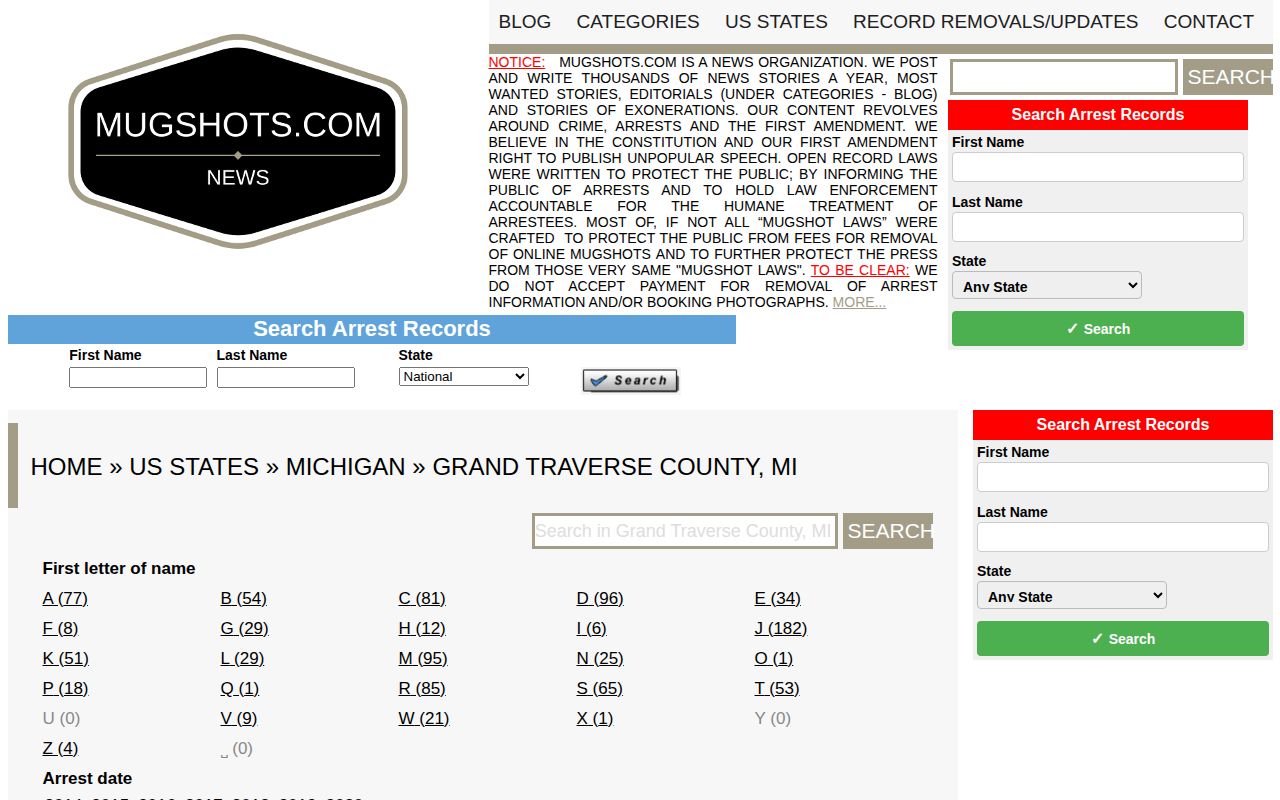
Names, faces, dates, and charges from such a site all need official confirmation. No local section exists for Busted Newspaper, RecentlyBooked, Arrests.org, or Mugshots.zone. A private copy of an arrest record cannot prove present custody or a final charge.
Blotter work has limits. Write down when you checked each source. Keep the source name with what you copied. When dates conflict, go get the government record itself. A news headline, an old photo, or a roster entry rarely tells the whole Grand Traverse County arrest story.
A released person can vanish from the jail inquiry. That gap is not a missing case. Ask instead for the admission and release record. Arrest events inside Traverse City often split across two offices. The city police hold the incident report, while county Corrections keeps the jail record. Kingsley and Fife Lake lean on county sheriff channels for local custody questions. A broad blotter search can miss what one focused agency request finds.
Photos need context too, since a news image, an old unofficial copy, and a jail booking photo are not the same thing. For a Grand Traverse booking photo, the Sheriff's Office is the custodian to ask. Court records then show what happened next.